2/7/2026 · Portfolio Admin
I Was Tired of Guessing What Job Descriptions Actually Meant — So I Built This
Synced from Medium RSS
I Was Tired of Guessing What Job Descriptions Actually Meant — So I Built This
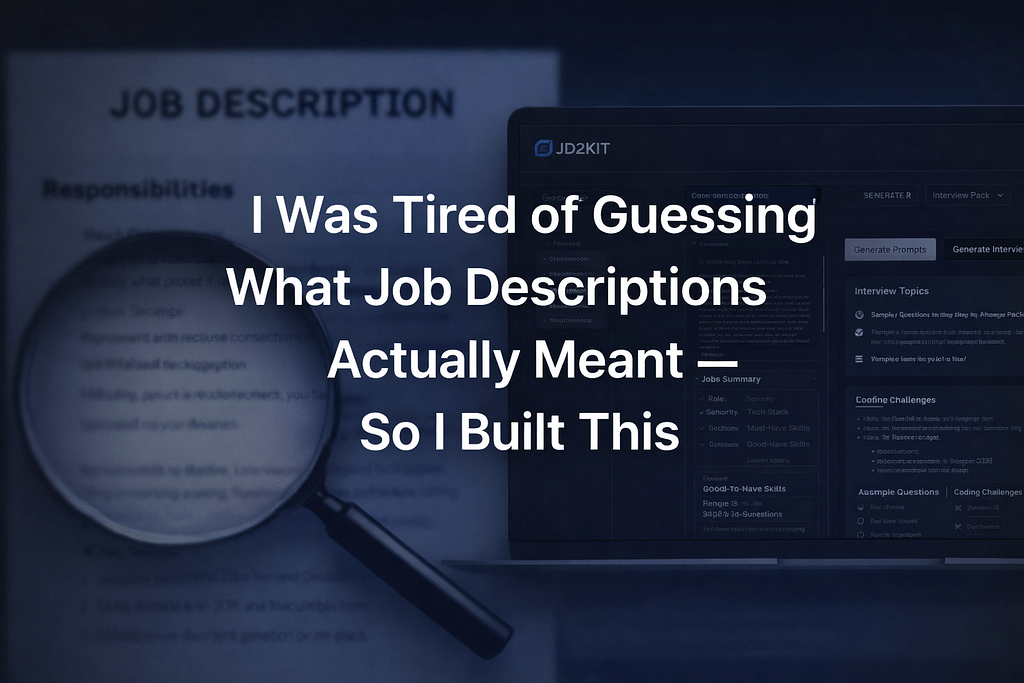
Every job description looks confident. But most of them hide the truth. As a candidate, you read a JD and wonder:
- What skills actually matter?
- What can I ignore?
- What will the interview really test?
- How do I tailor my resume without rewriting my life story?
As a recruiter or hiring manager, you face the opposite problem:
- JDs written by multiple stakeholders
- Vague skill requirements
- Misalignment between resume screening and interviews
- Candidates preparing in completely different directions
Both sides are guessing.
That gap — between unstructured job descriptions and structured hiring clarity — is what pushed me to build JD2KIT.
The real problem with Job Descriptions
Job descriptions are not designed to be consumed by humans.
They are:
- Copied from old templates
- Edited by multiple people
- Optimized for posting, not understanding
- Packed with buzzwords and mixed signals
Yet we expect candidates to:
- Rewrite resumes
- Prepare interviews
- Decide what to study
…all from this messy input.
That’s broken.
What if a JD could explain itself?
That was the core question.
What if you could take a raw JD and turn it into:
- A clear role definition
- A skill breakdown
- A preparation roadmap
- A structured interview plan
Not manually.
Not in a spreadsheet.
But automatically — and transparently.
That idea became JD2KIT.
What JD2KIT does (without the jargon)
You paste a Job Description.
JD2KIT then:
Understands the role
- Extracts role title, domain, seniority
- Separates must-have vs good-to-have skills
- Identifies the real tech stack
Creates structured outputs
- A clean job.json (human-readable, editable)
- Resume rewrite prompts (ATS-aware)
- Impact-focused resume bullet prompts
- Cover letter guidance
Builds an interview preparation pack
- Topics to study
- Categorized interview questions
- Expected answer structures
- Follow-up questions
- Coding tasks (if relevant)
- System design prompts (for senior roles)
Everything stays tied to that specific JD.
No generic advice.
No “top 50 interview questions” nonsense.
Who this is useful for
Developers
- Stop over-preparing irrelevant topics
- Understand what the company is really hiring for
- Prepare interviews with direction, not anxiety
HR & Recruiters
- Break down vague JDs into structured requirements
- Align resume screening and interview expectations
- Build better interview frameworks
Students & Career Switchers
- Know exactly what to study for a role
- Avoid preparing blindly or copying random roadmaps
How to try it (2 minutes)
The app is live here:
Steps:
- Paste a Job Description
- Review the structured breakdown
- Generate prompts or interview pack
- Copy or download what you need
📌 Best experience on desktop/laptop
(Mobile UI polish is still in progress)
Why I built this as a system, not a chatbot
I didn’t want another “chat with AI” tool.
I wanted:
- Repeatable outputs
- Versioned history
- Editable structure
- Clear separation between input, understanding, and guidance
JD2KIT is intentionally opinionated:
- The JD is the single source of truth
- Everything else is derived from it
- You can inspect and correct the structure before generating anything
That’s how trust is built.
What’s next
This is v1.
Planned next:
- Auth + saved profiles
- Role-specific templates (HR vs Dev vs PM)
- Better mobile UX
- Pricing tiers for heavy users
- Exportable interview prep formats
But before all that — feedback matters more.
If you try it
I’d love to know:
- Which role you tested it with
- What felt useful
- What felt confusing
- What you’d want next
You can DM me, comment, or just share it with someone who’s preparing for interviews right now.
Hiring and job prep shouldn’t feel like guesswork.
I’m trying to fix one small piece of that.